Mansard and Double Mansard Structural Systems
Structural Engineering and Load-Bearing Framework
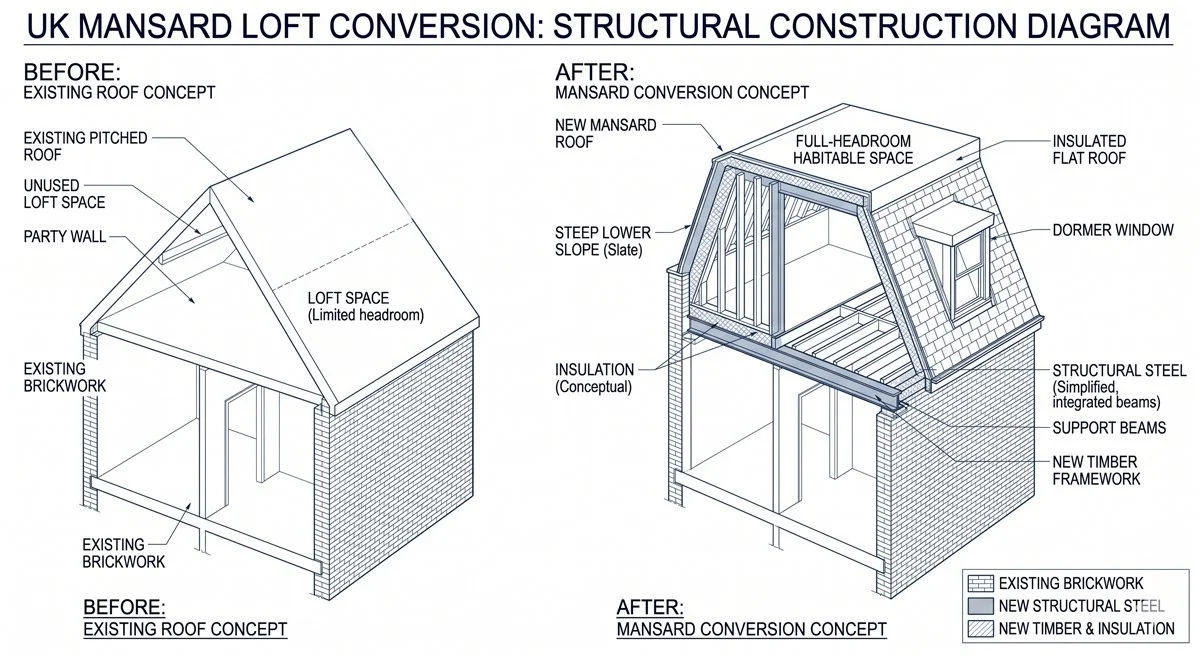
A mansard loft conversion represents one of the most significant structural modifications a residential property can undergo. Unlike a simple roof light conversion, a mansard involves the near-total removal of the existing roof structure to facilitate a new, high-volume living space. The defining characteristic is the 72-degree slope of the rear wall; this specific angle is a critical planning requirement, as it ensures the extension is legally classified as a roof rather than an additional storey.
The primary challenge in a double Mansard Conversion is the management of dead and imposed loads. Because the original ceiling joists are rarely designed to support the weight of a habitable room, engineers must specify a new floor hierarchy.
Steelwork Integration: A series of Universal Beams (RSJs) are typically installed from party wall to party wall. These beams bear the weight of the new floor and the vertical timber stud work.
Floor Joists: New timber joists are oversized and fitted between the steel beams to prevent deflection. This ensures the ceiling of the rooms below remains undisturbed and structurally sound.
The 72-Degree Geometry: To the layman, the slope is an aesthetic choice; however, for the surveyor, it is a tool for planning compliance. By pitching the wall at 72 degrees, the structure adheres to local authority guidelines that seek to maintain the traditional character of Victorian and Edwardian terraces.
Planning Policy and Building Regulation Compliance
Every mansard loft conversion must satisfy the stringent requirements of the Building Regulations 2010. These are not merely suggestions but legal mandates to ensure the safety and efficiency of the dwelling.
Approved Document B (Fire Safety): Converting a loft into a habitable space turns a two-storey house into a three-storey building. This necessitates the installation of fire-rated doors (FD30) to all habitable rooms leading to the staircase, ensuring a protected escape route. Mains-linked smoke alarms must be installed on every level.
Approved Document L (Conservation of Fuel and Power): To meet modern thermal efficiency standards, the new roof and walls must achieve specific U-values. High-performance PIR insulation boards are cut to fit between and over the rafters to minimise thermal bridging.
Party Wall Act 1996: Since the new steel beams usually rest on the shared boundary walls, a formal Party Wall Agreement is often required. This legal process protects both the homeowner and the neighbour from potential structural disputes.
The Double Mansard Configuration
A double Mansard Conversion extends this principle to both the front and rear elevations of the property. While this maximises internal floor area, it is subject to stricter planning scrutiny. In many conservation areas, a front-facing mansard is prohibited to preserve the street scene. Where permitted, it involves complex scaffolding arrangements and a total rebuild of the roof plate; this often requires the temporary relocation of the occupants during the heavy structural phase.
Technical Feasibility and Structural Assessment
Executing a mansard loft conversion requires absolute engineering precision and strict adherence to UK statutory frameworks. If you are preparing a vertical extension project and require expert architectural design, structural calculations, or Party Wall Act guidance, contact our engineering office directly.
Our technical surveyors provide comprehensive site assessments to ensure your proposed design achieves full compliance with the Building Regulations while optimising internal spatial efficiency.
Contact us today to arrange a formal feasibility review for your property.